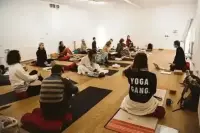
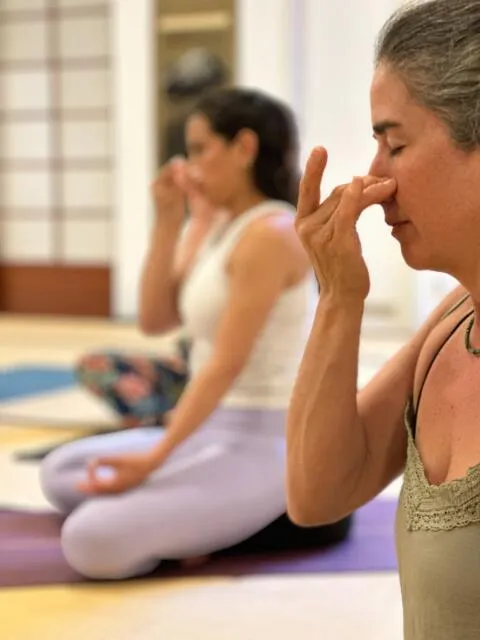
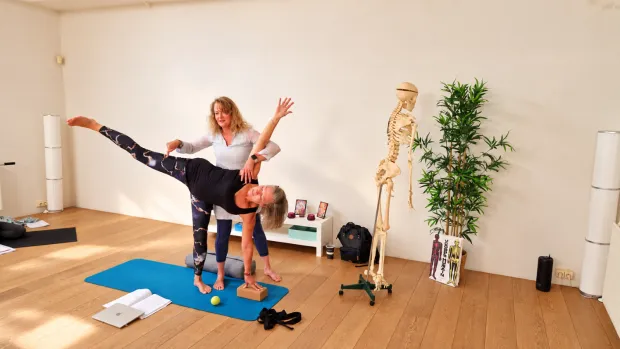
Yoga is everywhere. We see it in studios, retreats, fitness classes, wellness programs, and social media feeds. We associate it with movement, flexibility, strength, breathwork, and increasingly, mindfulness. But beneath the modern image of yoga lies a much older and deeper question:
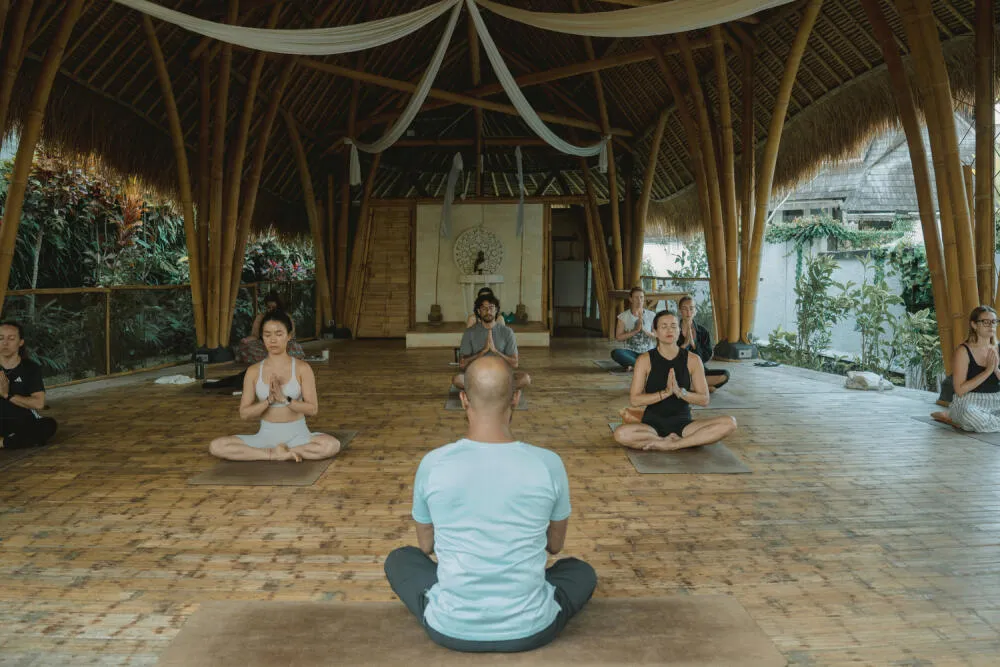
Who are we beyond the body and the mind?
This question sits at the heart of traditional yoga philosophy, and few texts explore it as beautifully as the Bhagavad Gita.
The Bhagavad Gita is often described as a Hindu scripture, but its teachings reach far beyond a particular religious identity. It is a philosophical dialogue about consciousness, action, purpose, attachment, devotion, meditation, and ultimately, self-realization. It asks us to look beyond what we can see and experience through the senses and investigate what lies deeper within.
For traditional yoga, this is where spirituality begins.
What Is the Bhagavad Gita?

The Bhagavad Gita, meaning "Song of the Divine," is a 700-verse philosophical dialogue contained within the Mahabharata, one of the great Sanskrit epics of India. It is traditionally attributed to the sage Veda Vyasa, although the history and composition of the Mahabharata are complex and have been debated by scholars.
The Gita takes place on the battlefield of Kurukshetra, where Prince Arjuna is preparing to fight a war against members of his own family and community. Faced with the possibility of causing immense suffering, Arjuna becomes overwhelmed by doubt. He puts down his weapon and refuses to fight.
His charioteer, Krishna, then begins to teach him.
What follows is not simply advice about war. Krishna uses Arjuna's crisis to explore some of life's biggest questions: What is our duty? What makes an action right? Who is the person performing the action? Why do we suffer? What is the Self? How can we become free?
In this sense, the battlefield becomes a powerful metaphor for the human condition.
We may not be standing on a battlefield, but we constantly face our own inner conflicts: fear versus courage, desire versus wisdom, attachment versus freedom, and the voice of the ego versus the deeper awareness within us.
The Real Battle Happens Within
Arjuna can be understood as the ordinary human being: intelligent, capable, but confused when confronted with life's contradictions. Krishna represents a higher level of wisdom and consciousness guiding him toward clarity.
The conversation between them can therefore be read as an inner dialogue.
How often do we know what we should do, but struggle to do it?
How often do fear, attachment, expectations, or the desire for a particular outcome influence our decisions?
The Bhagavad Gita addresses precisely this human struggle.
Krishna teaches Arjuna about dharma, the responsibility or purpose appropriate to one's life, and explains that action itself is not necessarily the problem. Our attachment to the results of our actions is what binds us.
This becomes the foundation of Karma Yoga, the path of selfless action.
The teaching is not "stop caring." It is almost the opposite. Act fully. Act responsibly. Give your best. But learn to release your attachment to the outcome.
That is a powerful lesson even outside a spiritual context.
Four Paths, One Destination
One of the most fascinating aspects of the Bhagavad Gita is that it does not present a single way toward spiritual development. It describes different approaches according to different human tendencies.
These became associated with four major paths of yoga.
- Jnana Yoga — the path of knowledge explores reality through inquiry, study, discrimination, and self-knowledge. It asks: Who am I?
- Bhakti Yoga — the path of devotion develops love, surrender, gratitude, and connection with the Higher Self. It asks us to move beyond the limitations of the individual ego.
- Karma Yoga — the path of selfless action transforms everyday responsibilities into spiritual practice by acting without attachment to personal reward.
- Raja Yoga — the path of meditation focuses on mastering the mind through concentration, meditation, and inner discipline.
These paths may look different, but their purpose is ultimately connected: self-realization.
This is one reason traditional yoga is so much more than asana. Physical practice can be part of the journey, but the journey itself is much larger.
So, What Is Spirituality?
The word spirituality can sometimes sound vague. It can also be confused with religion.
In the context of yoga, spirituality can be understood more simply: the recognition and direct exploration of consciousness beyond our ordinary identification with the body, mind, possessions, and experiences.
It begins with a surprisingly simple question:
Am I only this body and mind, or am I also consciousness?
Yoga philosophy invites us to investigate that question for ourselves.
Spirituality does not necessarily require adopting a particular belief system. It is about experiencing and understanding something deeper than the material aspects of life.
This is where the yogic concept of vairagya, or non-attachment, becomes important. Vairagya does not mean rejecting the world or giving away everything you own. It means learning not to be controlled by our attachment to things, experiences, identities, and outcomes.
We can enjoy something without needing to possess it.
We can act without needing recognition.
We can experience success without believing it defines us.
We can experience difficulty without believing it is who we are.
That movement from attachment toward freedom is deeply spiritual.
Spirituality Is Not the Same as Religion

Yoga and religion are often placed in the same category, but they are not identical.
Religion can include spirituality, but it may also involve doctrine, rituals, traditions, rules, beliefs, and a shared community. Spirituality, in the yogic sense, is more inward. It is concerned with your direct relationship with consciousness and the meaning of your own existence.
This does not mean religion is inherently negative, nor that spirituality is inherently separate from religion. Many religious traditions contain profound spiritual teachings. The distinction is simply important because spiritual experience does not depend entirely on belonging to a particular religious system.
Traditional yoga does not require everyone to follow the same religious identity.
In fact, yoga philosophy provides different ways of approaching the question of higher consciousness. Concepts such as Purusha, the principle of pure consciousness, point toward something deeper than our changing physical and mental experiences. Ishwara can also be used as an object of meditation within the Yoga tradition, without requiring the practitioner to adopt a particular religious framework.
This openness is one reason yoga has travelled so successfully across cultures.
Spirituality Is Something You Experience
Perhaps the most important thing about spirituality is that it cannot be fully understood through intellectual explanation.
You can read hundreds of books about meditation.
You can study the philosophy of consciousness.
You can listen to teachers explain mystical experiences.
But none of these is the same as experiencing stillness for yourself.
Think about the moments when you have completely lost track of time. Perhaps you were sitting quietly in nature, deeply immersed in music, meditating, creating something, or simply experiencing a moment of profound presence.
There may have been no complicated belief attached to it.
You were simply there.
This is why spiritual traditions place such importance on direct experience.
William James, one of the founders of modern psychology, famously explored mystical experiences and described them as difficult to express through ordinary language. Some experiences are understood only when they are lived.
Yoga takes this idea seriously.
You don't practice meditation simply to know about stillness.
You practice to experience it.
You don't practice pranayama simply to learn breathing techniques.
You practice to experience the relationship between breath, energy, mind, and awareness.
And you don't study yoga philosophy merely to collect information.
You study it so that it can change the way you experience yourself and the world.
Why Spirituality Matters in Yoga
This is where traditional yoga differs significantly from yoga understood only as physical exercise.
Asana can strengthen and prepare the body. Pranayama works with the breath and pranic energy. Meditation develops concentration and awareness. Philosophy provides a framework for understanding the experience.
Together, they create a complete system of practice.
In the classical tradition, the goal of yoga is self-realization—ultimately expressed as freedom or Kaivalya in the Yoga Sutras of Patanjali.
The body is not the enemy. The mind is not the enemy. The world is not the enemy.
The practice is about understanding our relationship with all of them.
This is why spirituality is not something that needs to be added to yoga as an extra feature. From the traditional perspective, spiritual inquiry is already at the heart of yoga.
Yoga Begins Where the Pose Ends
Perhaps this is the most important lesson.
You can become stronger without becoming more aware.
You can become more flexible without becoming more free.
You can learn to perform an impressive posture without ever asking why you are practicing it.
Traditional yoga asks a different question.
What is happening within you?
What happens to your mind when you breathe consciously?
What happens when you sit in stillness?
What happens when you release attachment?
What happens when you observe your thoughts rather than becoming every thought?
And eventually:
Who are you beneath all of it?
This is the deeper territory explored by the Bhagavad Gita and the broader yoga tradition.
As Swami Vivekananda expressed it:
"Each soul is potentially divine."
Yoga is not necessarily about becoming something you are not.
It is about removing the layers that prevent you from experiencing what is already within.
Discover Traditional Hatha Yoga in Bali
As yoga has become increasingly popular around the world, much of its original depth has been simplified into movement-based exercise. While physical practice offers many benefits, the classical teachings remind us that Hatha Yoga was never intended to end with the body. It was designed as a practical path toward inner transformation and ultimately, deeper states of yoga and meditation.
At SKY Yoga & Meditation, we honour these traditional teachings through an authentic Yoga Teacher Training rooted in classical Hatha Yoga. Rather than focusing only on postures, our curriculum explores yoga philosophy, pranayama, bandhas, mudras, meditation, yogic scriptures, and subtle energy practices that have guided practitioners for centuries.
Whether your goal is to become a yoga teacher or simply deepen your personal practice, our training invites you to experience yoga as a complete system—not simply as exercise, but as a lifelong path of self-discovery.
If you're looking for a Traditional and Authentic Yoga Teacher Training in Bali, explore the 200-Hour Yoga Teacher Training at SKY Yoga & Meditation. Learn from experienced teachers in a peaceful eco-village near Ubud and discover the deeper meaning of yoga through an immersive experience rooted in authentic tradition.
Because sometimes the most important yoga practice isn't the one that changes your body. It's the one that changes the way you see yourself.